Start with something that will actually be used
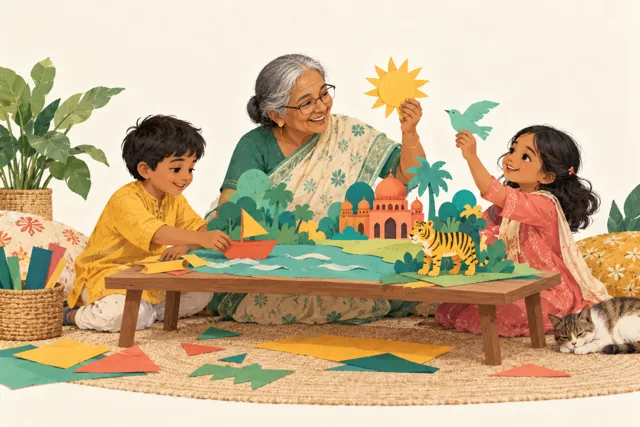
Choose one piece of the occasion to make together: a welcome picture, a card for a relative or an illustrated invitation. A clear purpose gives the activity a natural finish. “We are making a card for Dadu's visit” is easier to work with than announcing a whole afternoon of celebration preparation. Keep the materials and the activity under the responsible adult's supervision.
You do not need to promise guests a finished masterpiece. If the child decides to stop, an adult can complete the practical invitation separately. Their contribution should not determine whether people receive the address or know when to arrive. Adults remain responsible for the event; the child is being invited into a small creative part of it.
Give choices that you can honour
Offer a few genuine options about the picture or greeting. Perhaps the card can show a bus, a flower or the family cat. Avoid asking an open question and then rejecting every answer because you already wanted a particular design. If some details are fixed, say so: the adult will write the date, while the child can choose the picture beside it.
A choice can also be made by pointing or selecting an existing drawing. No particular level of writing or drawing is required for this family activity. You are not testing what the child ought to be able to do. If they prefer watching, that can be their part today, and you can continue without making the decision a disappointment.
Keep their words before polishing them
Ask what the picture says or what message they want to send. Write down the words they offer, if they want you to. Read the sentence back and ask whether it belongs on the card. An unexpected phrase may be the most personal part of the invitation. You can place the practical event details in a separate adult-written area.
Do not quietly replace their wording with a polished message and still present it as entirely theirs. If you edit for clarity, explain the change. A joint card can honestly have both voices: “Picture and greeting by Mina; details added by the family.” Ask before using the child's name in a version that will travel beyond familiar recipients.
Make a display with a small number of decisions
If you are decorating together, begin with a modest arrangement that the adult can manage: choosing which drawings to display or deciding the order of paper pictures. Let the child see the proposed arrangement before the adult installs it appropriately. This is about choosing and making, not instructions for a child to climb, fix or handle equipment.
Photograph the arrangement only if you want a private record. The child does not need to pose beside it or explain it to every guest. You can tell visitors who contributed without turning the contribution into a performance. If someone asks about a picture, offer the child the choice to answer or let you describe it.
Try a simple invitation example
Imagine a small family tea. The child chooses a drawing of a yellow bus and suggests, “Come to our house and tell a story.” The adult checks the guest details and writes the time separately. Before sending, you review the whole card together. The illustration and greeting are the child's contribution; invitation accuracy and distribution stay with the adult.
This division also makes revision easier. If the time changes, you can correct the practical line without treating the drawing as wrong. If the child wants to make a second version, decide whether there is time, rather than promising unlimited preparation. One finished card can be enough even when the occasion has several guests.
Give the finished work an ending
After the event, ask whether to keep the card, photograph it privately or put it with a small selection of drawings. Do not assume every decoration must be stored forever. Say what you enjoyed about making it together, such as the surprising greeting or the chosen colours, rather than judging whether it looked professional.
Next time, the child may choose a different role or none at all. The point is an invitation into a real family task with room for their preferences. A celebration can contain something they helped make without asking them to host it, perform for it or make it look perfect.